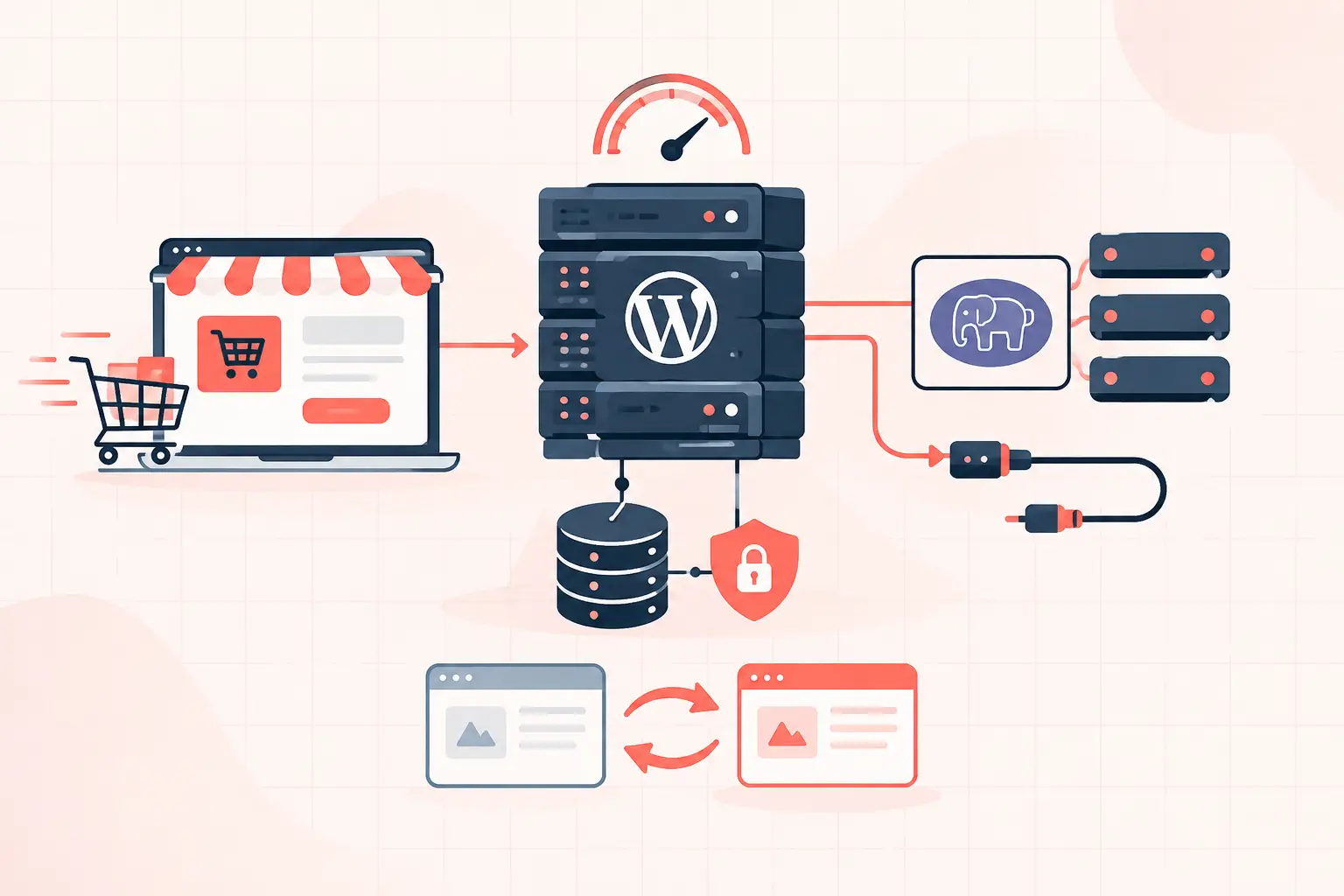

A proper WordPress plugin conflict diagnosis does not start by randomly disabling extensions on a live store. Capture the failure, reproduce it under controlled conditions, identify the request and error involved, then isolate the smallest combination of active code that causes it. That process protects revenue, preserves evidence, and avoids mistaking a slow server or stale cache for a plugin problem.
The fastest safe path is usually: restore or clone production into staging, enable logging, disable plugins in groups, narrow to one plugin, then test the conflicting pair against the active theme, PHP version, and cache layers. If checkout, login, or admin screens are affected, treat the incident as urgent because full-page caching will not protect those requests.
Start with evidence, not the plugin screen
A conflict has a recognizable symptom: a critical error after an update, an endless checkout spinner, a white screen, missing admin controls, duplicate API calls, or a page that slows down only for logged-in users. Write down the exact URL, user role, time of failure, browser console message, and steps needed to trigger it.
Then check the server and WordPress logs. A fatal PHP error naming two plugins is useful evidence, but it is not always the root cause. One plugin may expose an outdated function call in another. A memory exhaustion error can point to a plugin loop, an oversized autoloaded option, too few PHP workers, or a low PHP memory limit. The distinction matters before you remove something that the site actually needs.
Enable WordPress debug logging on staging first. Add these lines to `wp-config.php`, above the line that says to stop editing:
define('WP_DEBUG', true); define('WP_DEBUG_LOG', true); define('WP_DEBUG_DISPLAY', false);Never leave error display enabled on a production site. It can expose filesystem paths, plugin names, and other details to visitors. Review `wp-content/debug.log` immediately after reproducing the issue, then turn debugging back off when the investigation is complete.
Build a safe environment for diagnosis
Staging should be a close copy of production: same PHP version, WordPress version, active theme, plugin versions, database, object cache behavior, and server rules. A conflict that vanishes on a generic test site may depend on a production-only payment gateway setting, a WooCommerce Action Scheduler backlog, or a cached option in Redis.
Before changing anything, create a database and file backup that you can restore quickly. This is especially important when a plugin update changes database tables or runs migration routines. Deactivating a plugin is normally reversible. Clicking "delete data on uninstall" or rolling back database changes is not.
For a WooCommerce store, use a payment gateway sandbox where possible. Verify product pages, cart updates, coupons, shipping calculation, checkout, account login, order creation, transactional email triggers, and webhooks. A plugin conflict can appear only after an order reaches a specific status.
Run the WordPress plugin conflict diagnosis methodically
Confirm the failure with caches controlled
Clear application, page, CDN, and browser caches before every meaningful retest. Exclude checkout, cart, account, login, and admin routes from page cache. Otherwise, a cached page can make a broken plugin look healthy, while an uncached AJAX or REST request continues failing behind the scenes.
Also check object caching. Redis or Memcached does not create a code conflict, but stale cached objects and transients can preserve bad behavior after you disable a plugin. Flush object cache only in a controlled window, particularly on busy stores, because it can temporarily increase database load and TTFB.
Disable plugins in halves
Do not deactivate 40 plugins one at a time. Disable roughly half, retest the exact failure, and continue with the half that retains the problem. This binary search approach reduces a 32-plugin investigation from 32 tests to about five rounds.
Keep a simple record of each round: active plugins, test result, error output, response time, and whether caches were cleared. Plugin conflicts are often intermittent when cron jobs, queued actions, external APIs, or race conditions are involved. Notes prevent you from chasing a result you cannot reproduce.
If the failure disappears when a group is disabled, reactivate half of that group. Continue until one plugin remains. Then activate it with the suspected companion plugin or active theme. The final test should prove the condition clearly:
- Plugin A works alone.
- Plugin B works alone.
- Plugin A and Plugin B fail together.
- The failure changes or disappears with a particular theme, PHP version, or cache layer.
That is a diagnosis, not a guess.
Use WP-CLI when wp-admin is unavailable
A fatal error can lock you out of the dashboard. WP-CLI lets you inspect and change plugin state without loading wp-admin:
wp plugin list --status=active wp plugin deactivate plugin-slug wp plugin activate plugin-slug wp plugin deactivate --allOn a multisite installation, confirm whether the plugin is network-activated. Deactivating a site-level plugin will not help if the code remains active network-wide. If WP-CLI is unavailable, temporarily rename the target plugin directory via SFTP or the server file manager. Rename only one directory at a time, and restore the original name after the test.
Separate true conflicts from resource failures
Many reports labeled "plugin conflict" are capacity failures. A visual builder, analytics suite, security scanner, and WooCommerce can coexist functionally but overwhelm a constrained PHP pool during a traffic spike. The visible symptom may be 502 or 504 errors, failed AJAX calls, or checkout requests that time out.
Check the request timing and server metrics. High CPU, saturated PHP workers, slow database queries, or elevated disk I/O point to a resource issue. A slow admin page can also result from bloated autoloaded options or repeated external HTTP calls. Query Monitor on staging is useful for identifying slow hooks, duplicate queries, HTTP API requests, and excessive memory usage, but do not leave diagnostic tooling active on production indefinitely.
Database evidence matters too. If a plugin adds expensive queries to `wp_options`, post meta, or WooCommerce order tables, it may not crash the site but can materially increase TTFB. Deactivation proves association. Query analysis explains the mechanism and tells you whether configuration, cleanup, replacement, or more server capacity is the right fix.
Check version compatibility before blaming code
Test the isolated plugin against the current active theme, WordPress core version, WooCommerce version if applicable, and current PHP version. Deprecated PHP behavior often surfaces after a host upgrades PHP, while an old WooCommerce extension may fail after a database schema or checkout-block change.
Read the fatal error carefully. Common patterns include undefined functions, missing classes, incompatible method signatures, invalid REST nonce behavior, and JavaScript errors caused by two plugins loading different versions of the same library. Browser developer tools can reveal the last case: a 403, 500, or JavaScript exception on an AJAX request is often more specific than the broken interface it produces.
Avoid the tempting "fix" of permanently pinning WordPress, PHP, or WooCommerce to old versions. A temporary rollback can stabilize a revenue-critical site while you work, but it also extends security and compatibility risk. The durable answer may be an update from the vendor, a configuration change, a code patch maintained by your team, or replacing an abandoned extension.
Resolve the conflict without creating a second outage
Once you have a confirmed pair or condition, decide whether the feature is essential. If not, remove the weaker plugin and delete its unused data only after a verified backup. If both are essential, look for settings that overlap: duplicate minification, multiple schema generators, competing checkout customizers, two firewall layers, or separate image optimization engines rewriting the same files.
For custom code, move small snippets out of an unmaintained plugin and into a version-controlled custom plugin. Do not bury business logic in a theme's `functions.php` if the behavior must survive a theme change. Test deployment and rollback procedures before touching production.
A quality managed environment reduces the blast radius here. Hourly backups, staging clones, server-level caching, isolated PHP resources, and high-frequency CPU capacity make testing and recovery more predictable. WP Tango's Ryzen 9950X-based platform is designed for that operational reality, but infrastructure still cannot compensate for incompatible code indefinitely.
Prevent the next conflict
Update plugins in controlled batches, not all at once on a Friday afternoon. Record the plugin inventory, remove inactive extensions, and keep licenses current so security and compatibility releases are available. For agencies, a short pre-production test checklist is cheaper than emergency debugging across multiple client sites.
The practical goal is not to run the fewest plugins. It is to run plugins with clear ownership, current maintenance, non-overlapping responsibilities, and a tested rollback path. When something breaks, preserve the evidence, isolate the condition, and make the smallest safe change. That is how you fix the immediate incident without planting the next one.