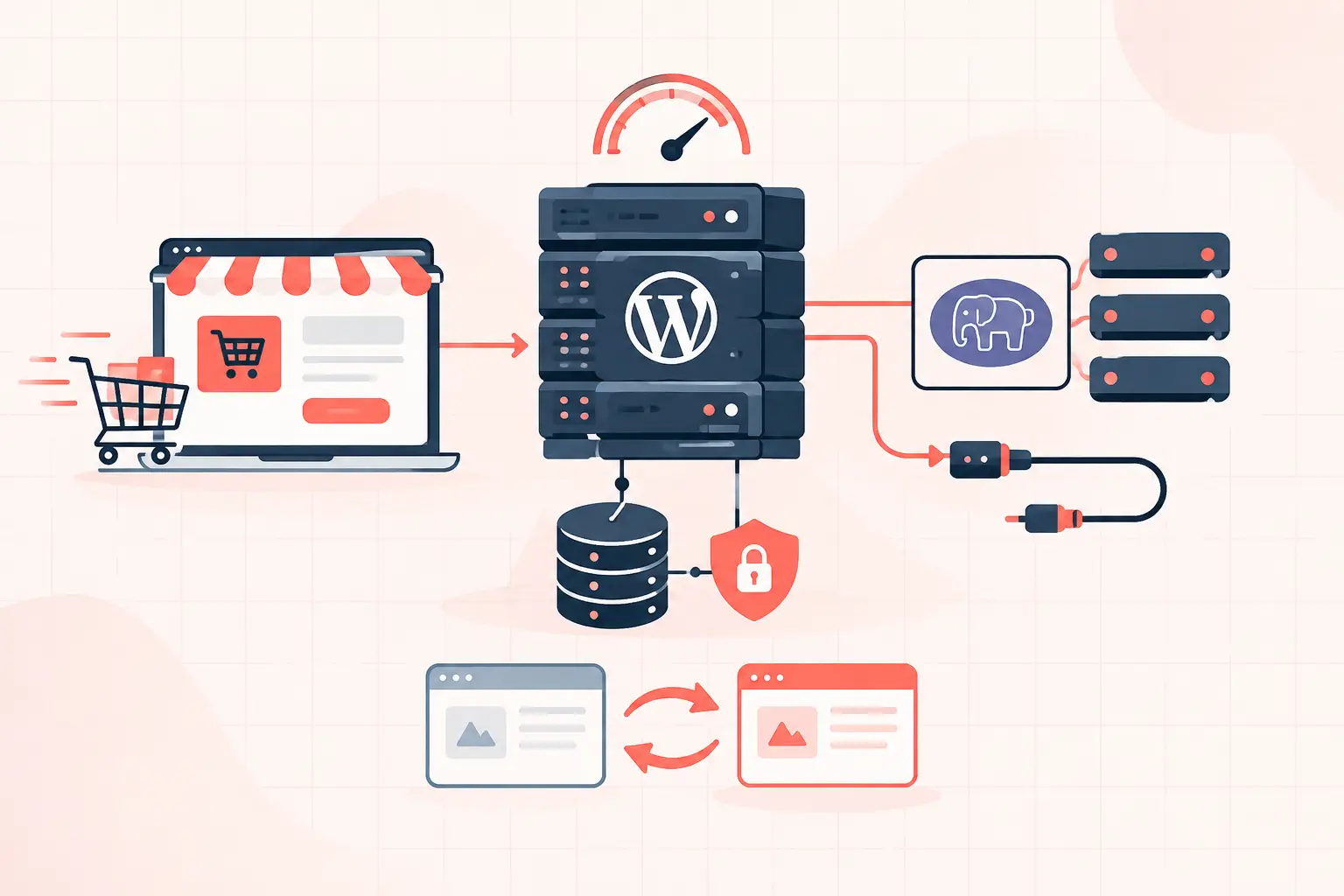


A WooCommerce timeout is rarely a mystery. When asking what causes WooCommerce timeouts, start with the request that failed: checkout, cart refresh, payment callback, admin action, or background job. Most failures come down to one of seven issues: exhausted PHP workers, slow database queries, blocked third-party API calls, CPU or memory pressure, cron backlog, plugin code conflicts, or an upstream server timeout that is shorter than the work being requested.
Do not begin by raising every timeout setting you can find. A longer timeout may hide the immediate symptom while tying up more PHP workers and making the store slower for every customer. First identify where the request is waiting, then remove the bottleneck.
What Causes WooCommerce Timeouts During Checkout?
Checkout is the most exposed WooCommerce workflow because it cannot be fully page-cached. Every shopper may trigger cart calculations, stock checks, shipping logic, tax rules, payment gateway communication, session updates, order creation, and transactional emails in one request.
A timeout occurs when one layer gives up before the request finishes. That layer might be the browser, Cloudflare or another proxy, NGINX, PHP-FPM, WordPress, MySQL, or a payment provider. The visible error may say `504 Gateway Timeout`, `502 Bad Gateway`, `cURL error 28`, or simply show an endlessly spinning checkout button. Those are different symptoms, but they often originate from the same resource problem.
1. PHP workers are saturated
PHP workers process dynamic WordPress requests. Unlike cached product pages, cart, checkout, account, REST API, and WooCommerce AJAX requests need a worker for the duration of the request.
If a store has four PHP workers and four slow checkout requests are already running, the fifth customer waits in a queue. If the wait exceeds a proxy or PHP timeout, that visitor gets an error. This is common during flash sales, paid traffic bursts, bot activity, and stores running heavy shipping or product add-on plugins.
Worker contention is not fixed by caching the homepage. You need to reduce the time each uncached request spends in PHP, add appropriate worker capacity, or both. Adding workers without enough CPU and database capacity can make the problem worse by allowing more expensive requests to run at once.
2. Slow or bloated database queries
WooCommerce depends heavily on the database. A checkout can touch customer metadata, sessions, products, inventory, coupons, orders, tax data, and plugin-specific tables. One poorly indexed query or oversized `wp_options` table can turn a normally fast request into a 30-second pileup.
Common database causes include autoloaded options that have grown to several megabytes, excessive transient rows, abandoned WooCommerce sessions, plugins querying order data with inefficient meta queries, and database tables missing indexes after a plugin migration.
The move toward WooCommerce High-Performance Order Storage helps reduce pressure from legacy `postmeta` order queries, but it does not repair every plugin. Extensions that still run broad searches across order metadata can remain expensive. Test compatibility before enabling or migrating production order storage.
3. A third-party API is slow or unreachable
Shipping rates, tax calculations, fraud checks, inventory systems, email providers, ERPs, and payment gateways all make remote HTTP requests. If an API takes 20 seconds to answer, PHP often waits for those 20 seconds. Under concurrency, that one dependency can consume every available worker.
`cURL error 28: Operation timed out` is the clearest sign. It does not automatically mean your server is slow. It means WordPress did not receive a response within the configured window. Check the destination hostname, DNS resolution, outbound firewall rules, and the provider's status before changing WordPress settings.
For shipping and tax tools, use cached estimates where the extension supports them. For post-purchase syncing, move nonessential work out of the checkout request and into a reliable background queue.
4. Action Scheduler and WP-Cron are backed up
WooCommerce uses Action Scheduler for recurring tasks and background jobs. Subscription renewals, webhooks, inventory syncs, email tasks, and plugin jobs can accumulate quickly. If scheduled actions run through normal site visits with WP-Cron, an unlucky customer request may inherit a large backlog.
A busy store should run WordPress cron from the server scheduler rather than relying on page loads. In `wp-config.php`, disable the visitor-triggered cron behavior:
define('DISABLE_WP_CRON', true);Then configure a real cron job to run at a sensible interval, commonly every one to five minutes depending on order volume. The exact command depends on the server environment, but the principle is constant: background work should not depend on a shopper visiting the site.
Also inspect failed and pending scheduled actions. A repeating failed task can create thousands of retries and turn an operational issue into a database and worker problem.
5. Plugin conflicts and expensive custom code
Not every timeout is infrastructure-related. A plugin can create an infinite loop, perform external requests on every cart update, recalculate an entire catalog during checkout, or hook into `woocommerce_checkout_process` with slow custom code.
Custom snippets deserve equal suspicion. A small function that loads all orders for a customer, loops through thousands of products, or calls a remote API synchronously may work on a staging site with three orders. It can fail under production traffic.
The cleanest diagnostic is controlled isolation. Clone the site to staging, reproduce the same cart and checkout path, then disable nonessential extensions in groups. Review WooCommerce Status logs and PHP error logs while testing. Do not disable payment, caching, or security plugins blindly on a live store during business hours.
6. CPU, RAM, disk, or database capacity is exhausted
A timeout can be the last visible symptom of an overloaded server. High CPU means PHP and MySQL get less execution time. Memory exhaustion can kill PHP processes. Slow disk I/O can delay database reads, writes, temporary tables, and session updates. A database with too few connections can make PHP requests wait before a query even starts.
Shared hosting plans often obscure these limits. A dashboard may show generous storage but provide very little CPU, memory, or concurrent PHP capacity when traffic rises. Look for actual measurements: CPU utilization, load average, PHP-FPM active and max children, memory use, MySQL slow queries, database connections, and disk wait.
High-frequency CPU performance matters particularly for WordPress because many requests are sequential and PHP-heavy. Modern dedicated hardware, such as AMD Ryzen 9950X systems, can reduce execution time substantially, but hardware is not a substitute for fixing a 40-second API call or a broken query.
7. Timeout values are misaligned
Several timeout limits may apply to one checkout request. For example, PHP's `max_execution_time` may be 60 seconds, PHP-FPM may terminate a worker at 60 seconds, NGINX may wait 30 seconds for an upstream response, and a CDN may have its own limit. The shortest relevant limit wins.
This creates confusing behavior: logs may show PHP still working while the shopper has already received a 504. Raising NGINX `fastcgi_read_timeout` might be appropriate for a known, legitimate long-running admin import. It is usually the wrong cure for a customer checkout that should finish in two to five seconds.
Use longer limits selectively. For normal storefront requests, treat a request taking more than 10 seconds as a performance incident worth investigating.
How to Find the Actual WooCommerce Timeout Cause
Start with timestamps. Reproduce the failure once, note the exact time and URL or AJAX endpoint, then compare records across the web server, PHP, WordPress, and database layers. A 504 in the NGINX error log, a fatal error in PHP logs, and a slow query at the same second tells a much clearer story than browser behavior alone.
Use this quick triage sequence:
| Symptom | Likely area to inspect first |
|---|---|
| Checkout slows only during traffic spikes | PHP worker queue, CPU, database connections |
cURL error 28 appears in logs | Payment, shipping, tax, or other remote API |
| Admin and storefront both become slow | Database, CPU, memory, disk I/O |
Cart fragments or wc-ajax requests hang | Plugin hooks, sessions, workers, object cache |
| Scheduled actions show large pending counts | WP-Cron configuration and Action Scheduler |
Enable slow-query logging at the database layer where available. Query Monitor is useful on staging or for an authenticated administrator during controlled testing, but do not leave diagnostic tooling active on a high-traffic production store. It adds overhead and can expose details you do not want broadly accessible.
For PHP, inspect PHP-FPM status if your host provides it. The critical signal is whether `max children reached` appears during the failure window. If it does, the question becomes why workers are occupied, not merely whether you can raise the worker limit.
Fix the Bottleneck Without Creating a Larger One
Fixes should match the failing layer. Optimize or replace the slow plugin when code is the problem. Add an index or clean oversized autoloaded data when the database is waiting. Configure server cron when scheduled work is invading customer requests. Increase PHP workers only after confirming CPU, memory, and MySQL can handle the resulting concurrency.
Use persistent object caching for frequently reused data, but understand its boundary. Redis can reduce repeated database reads and improve throughput; it will not make a payment gateway answer faster or rescue a plugin that performs a full order-table scan on every request.
After each change, test a real purchase path: guest checkout, logged-in checkout, coupon application, shipping selection, payment authorization, order confirmation, and confirmation email. A store that loads quickly but loses orders at the final click is not healthy.
The practical target is not a checkout allowed to run for 120 seconds. It is a checkout that consistently completes fast enough that workers stay available, customers stay confident, and a traffic spike does not turn one slow dependency into a store-wide outage.