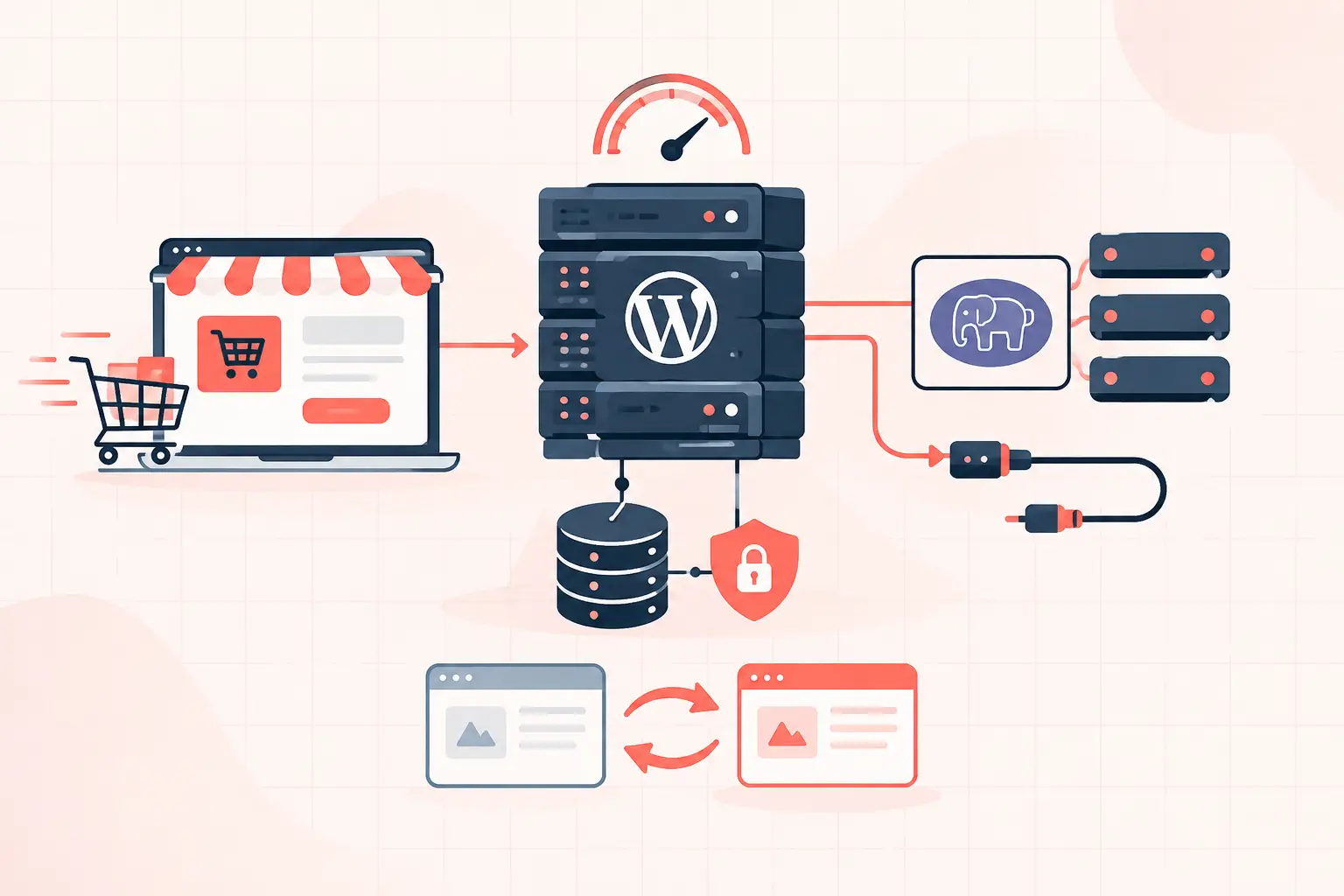

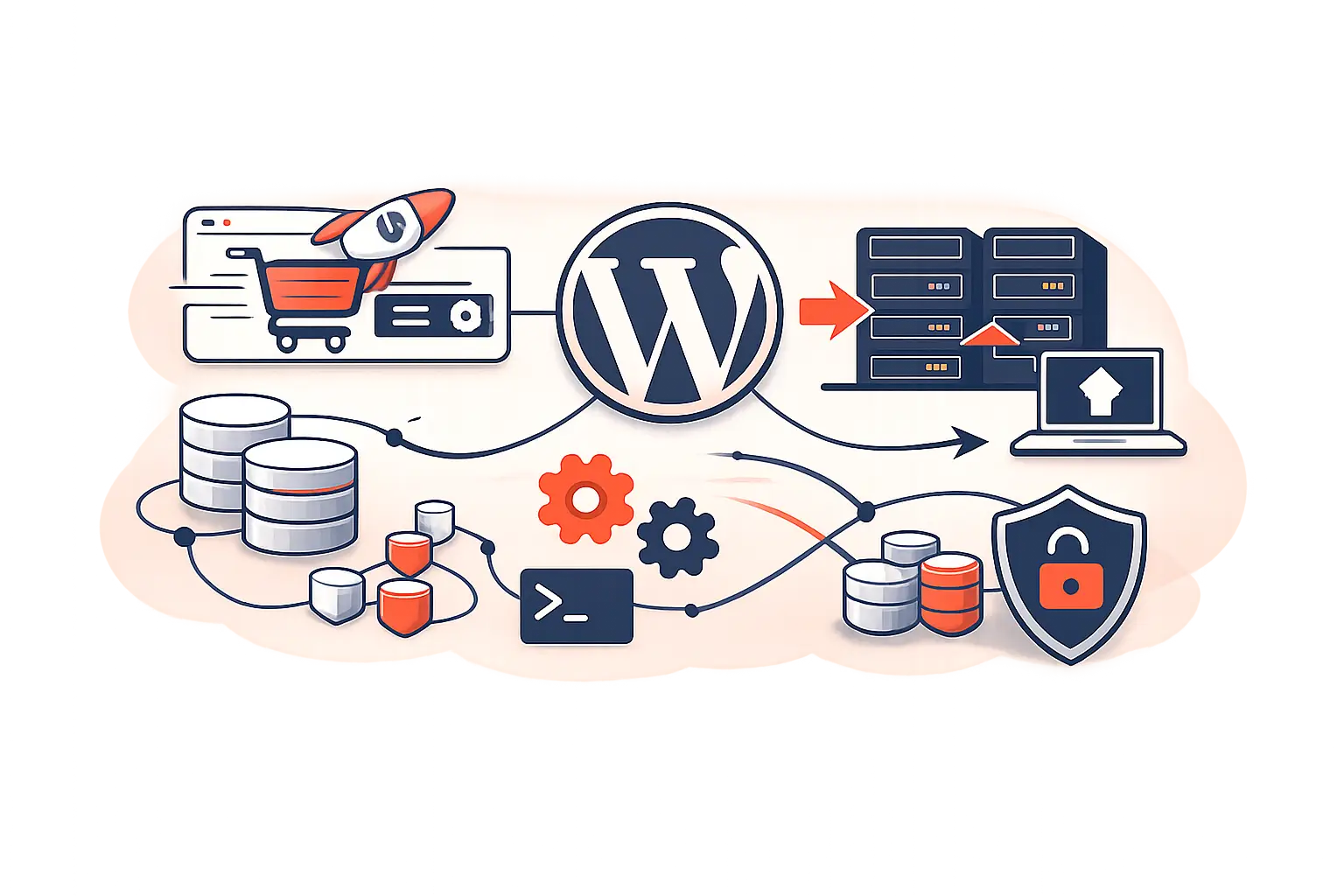
A timeout is not a WordPress diagnosis. It is the moment one layer gives up waiting on another. To resolve WordPress timeouts, identify which request is failing, measure where it stalls, and fix that bottleneck instead of raising limits blindly. A public page timing out points to PHP, database, cache, or upstream server capacity. A timeout during checkout, import, backup, or update often points to PHP worker saturation, slow external APIs, or a long-running database query.
Start by recording the exact failure: the URL, time, action being performed, whether it affects logged-in users only, and the HTTP status code. A 504 Gateway Timeout, 502 Bad Gateway, WordPress `cURL error 28`, and “Maximum execution time exceeded” look related in a browser, but they require different fixes.
Identify the timeout before changing settings
The fastest way to waste an afternoon is to increase `max_execution_time`, `memory_limit`, and PHP workers all at once. You may hide a symptom while allowing a bad query, broken API integration, or overloaded server to keep consuming resources.
Use this quick distinction:
| Symptom | Most likely layer | What to check first |
|---|---|---|
| 504 Gateway Timeout | NGINX, proxy, or load balancer waited too long for PHP | PHP-FPM logs, slow requests, worker utilization |
| 502 Bad Gateway | PHP process crashed, was unavailable, or upstream connection failed | PHP error log, memory exhaustion, PHP-FPM status |
cURL error 28 | WordPress could not complete an outbound HTTP request | API endpoint, DNS, firewall, plugin integration |
| Maximum execution time exceeded | PHP script exceeded its configured limit | Stack trace, plugin task, import/export logic |
| Database connection errors or stalled admin | MySQL/MariaDB is slow or unavailable | Slow query log, connections, locked tables |
Check web server, PHP, and database logs for the same timestamp. If your host only provides a generic “resource limit reached” message, ask for the actual metrics: CPU usage, RAM usage, disk I/O wait, PHP-FPM active workers, queued requests, and MySQL slow-query data. Without those, support is guessing.
Resolve WordPress timeouts caused by PHP worker contention
PHP workers process uncached WordPress requests. Every WooCommerce cart, checkout, account page, wp-admin action, REST API call, and logged-in session generally needs one. When all workers are occupied, new requests wait in line. Eventually, the web server reaches its timeout and returns a 504.
This is especially common on WooCommerce stores during promotions. Ten shoppers may not sound like heavy traffic, but checkout requests can occupy workers for several seconds if a payment gateway, tax service, inventory plugin, or database query is slow.
Confirm whether requests are queuing
Look for PHP-FPM messages indicating that the process manager has reached its child-process limit. A typical log message references `pm.max_children`. Also inspect slow PHP request logs, if available. A request taking 30 seconds is the real problem; adding workers only helps until the server runs out of CPU or memory.
On a server with command-line access, useful starting points include:
wp cron event list --due-now wp plugin list --status=active wp db checkThe first command can expose a backlog of scheduled tasks. The second helps isolate heavy plugins. The third checks basic database table health, although a clean result does not rule out slow queries.
If traffic is legitimate and CPU headroom exists, increase PHP workers carefully. More workers improve concurrency, but each worker consumes memory and adds database pressure. On an underpowered or overcrowded server, raising worker counts can turn a queue into a full outage.
For stores, exclude cart, checkout, account, and other personalized pages from full-page caching. Then make sure anonymous product and category traffic is actually cached. Serving cacheable catalog pages through PHP is an expensive way to create checkout timeouts.
Find slow plugins, hooks, and scheduled jobs
A timeout that begins after a plugin update is not subtle. Disable the suspected plugin in a staging environment first, then retest the failing action. If wp-admin is inaccessible, use WP-CLI or temporarily rename the plugin directory through file access. Do not deactivate your entire plugin stack on a live store during business hours unless the site is already down.
Query Monitor can help on staging or for an administrator-only test session. Pay attention to slow database queries, HTTP API calls, duplicate queries, and hooks with unusually long execution times. Common offenders include page builders loading excessive metadata, security plugins scanning files during requests, analytics extensions, inventory syncs, and abandoned import tools.
WordPress cron deserves special attention. WP-Cron runs when someone visits the site, which means a visitor can trigger a backup, feed import, image optimization batch, or subscription renewal task. That is poor scheduling for a busy commerce site.
Move cron to a real server scheduler and disable the traffic-triggered behavior in `wp-config.php`:
define('DISABLE_WP_CRON', true);Then configure a system cron to call WordPress at a sensible interval. The right frequency depends on the site. A store with subscriptions or time-sensitive inventory may need runs every minute or five minutes. A brochure site usually does not.
Fix database queries that make requests hang
Increasing PHP timeouts will not repair a database query that scans hundreds of thousands of rows on every request. WordPress sites commonly accumulate oversized `wp_options` tables, autoloaded plugin settings, expired transients, Action Scheduler records, post revisions, and orphaned metadata.
Start with autoloaded options. Large autoload payloads are loaded on nearly every WordPress request, including requests that do not need most of that data. Review unusually large entries before deleting anything. Some plugins store legitimate configuration there; the problem is often stale or badly designed data, not the table itself.
For WooCommerce, inspect Action Scheduler. Failed and completed actions can pile up when payment, email, fulfillment, or subscription integrations are busy. Purge old records only after confirming retention requirements and ensuring no active task is being removed.
A proper slow query log is better than database cleanup folklore. It identifies the exact SQL statement, execution time, rows examined, and frequency. From there, the fix may be a plugin update, a missing index, reduced query frequency, object caching, or replacing an extension that cannot operate efficiently at your catalog size.
Persistent object caching with Redis can reduce repeated database reads for options, transients, and common query results. It helps when the same data is requested repeatedly. It will not fix a slow third-party API call, a poorly built uncached report, or a database server that is already starved for CPU and I/O.
Investigate external API and cURL timeouts
When WordPress reports `cURL error 28`, the site is waiting on another service. That could be a payment processor, shipping calculator, email platform, license server, CDN API, geolocation provider, or internal service endpoint.
First determine whether the remote service is actually slow or unreachable from your server. Check the plugin’s logs and test the affected integration outside peak traffic. DNS failures, outbound firewall rules, IPv6 routing issues, and expired API credentials can all present as a timeout.
Do not raise the WordPress HTTP timeout globally unless you know why the remote request needs more time. A longer timeout means each stalled request holds a PHP worker longer. On WooCommerce checkout, that can multiply a third-party outage into a site-wide queue.
Where the integration allows it, use asynchronous processing for nonessential tasks such as CRM sync, review requests, image processing, or marketing events. Payment authorization and inventory validation need synchronous handling. A newsletter tag update does not.
Set timeout values as guardrails, not cures
Timeout settings should give valid work enough time to finish while stopping runaway requests from monopolizing the server. There is no universal correct number.
A modest PHP execution limit may be appropriate for normal page requests, while a controlled CLI import can safely run much longer. Likewise, an NGINX FastCGI timeout should align with your PHP limit and application behavior. If NGINX allows 120 seconds but PHP kills requests at 30 seconds, users may wait far too long for an error. If PHP allows five minutes for every frontend request, a blocked API can consume your worker pool.
Keep public requests short. Move imports, backups, report generation, bulk image jobs, and data synchronization to WP-CLI or background workers wherever possible. These jobs should have their own monitoring and failure alerts rather than competing with customer traffic.
Prevent the next timeout with capacity and observability
A site that times out only during traffic spikes may have no code defect at all. It may simply be running on a plan with too few PHP workers, weak single-thread CPU performance, constrained database resources, or shared neighbors consuming the same pool. That is an infrastructure problem, and plugin cleanup alone will not solve it.
Monitor TTFB, PHP worker utilization, database query time, cache hit rate, CPU, memory, and disk I/O before and during peak periods. For agencies, capture these metrics before launching campaigns or pushing a major WooCommerce update. A staging test that has no real concurrency cannot prove that checkout will hold under load.
Modern high-frequency CPU capacity, server-level object caching, isolated PHP resources, and recoverable hourly backups provide useful protection when traffic or code behaves badly. They do not excuse inefficient plugins, but they provide the operating margin a revenue-producing WordPress site needs.
Treat every timeout as evidence. Once you can name the blocked layer and the request causing it, the fix becomes smaller, safer, and far more likely to last.