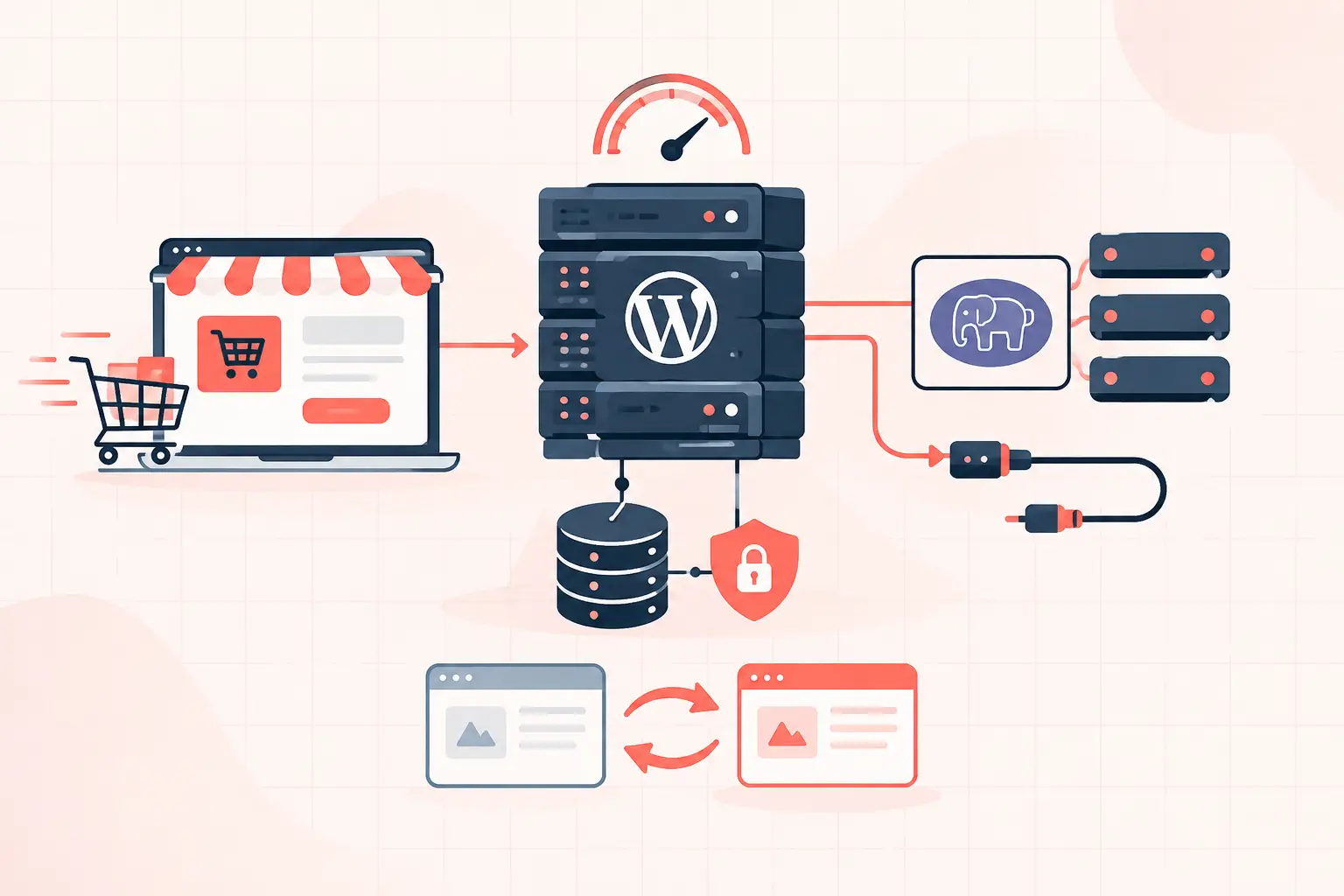


A WordPress hosting migration service should do more than copy files and point DNS. It should preserve database integrity, keep URLs and SEO signals intact, test dynamic site functions, and provide a rollback path before traffic reaches the new server. If your site earns revenue, has logged-in users, or runs WooCommerce, a migration is an operations task - not a file transfer.
The wrong process produces familiar damage: missing recent orders, broken password resets, mixed-content warnings, slow admin requests, redirect loops, and a homepage that looks fine while checkout fails. A competent migration service plans for those failure modes before the cutover.
What a WordPress hosting migration service should include
A proper migration begins with an inventory. The provider needs to know which site is being moved, but also what makes it stateful: WooCommerce orders, memberships, bookings, subscriptions, form submissions, external APIs, transactional email, object caching, cron jobs, and offloaded media.
The baseline deliverable is a full copy of WordPress files and the database. That is necessary, but it is not enough. The service should also account for the surrounding configuration that actually determines how the site behaves.
A migration plan should cover four areas:
- Content and database data: WordPress core files, uploads, themes, plugins, database tables, custom tables, and any files stored outside the normal document root.
- Server behavior: PHP version and extensions, memory limits, `max_execution_time`, upload limits, NGINX or Apache rules, HTTPS certificates, cron configuration, and object-cache settings.
- Application integrations: DNS records, email sending, payment gateways, CDN behavior, webhooks, search services, license keys, API allowlists, and third-party storage.
- Recovery controls: A verified pre-migration backup, a frozen change window when appropriate, a documented DNS plan, and a clear point at which the old host remains available for rollback.
For a brochure site, this can be straightforward. For an active store, the database changes every minute. Orders, stock changes, customer accounts, and payment status cannot be treated as static content.
Start with a pre-migration audit, not a backup button
Before anyone moves the site, capture how it performs and how it is configured. This gives you a way to spot regressions after cutover instead of guessing whether a slower checkout or higher TTFB is new.
Record the current PHP version, WordPress version, active theme, active plugins, disk usage, database size, and traffic patterns. Check for large tables such as `wp_postmeta`, `wp_options`, WooCommerce order tables, analytics logs, and abandoned-cart data. A bloated database may migrate successfully but still perform poorly on the new environment.
Also inspect the `wp_options` table for oversized autoloaded data. Autoloaded options are loaded into memory on many WordPress requests. A site with several megabytes of unnecessary autoloaded options can have a slow backend regardless of how fast the CPU is.
For command-line access, a dry-run URL replacement helps identify domain changes without touching production data:
wp search-replace 'https://old-domain.com' 'https://new-domain.com' \ --all-tables --precise --dry-runThe `--all-tables` flag matters because plugins often create their own tables. The `--precise` flag is slower, but it is safer for serialized data. Never use a raw SQL `REPLACE()` query on serialized WordPress values. It can corrupt string lengths and leave widgets, page builder content, or plugin settings broken.
For a same-domain migration, URL replacement may not be needed at all. Do not run it simply because it appears on a checklist.
Identify dynamic data before staging
A staging copy is valuable, but it becomes stale as soon as it is created. This is the central migration problem for stores and membership sites.
If the site accepts orders or registrations, ask how the final database sync will happen. Options include a short maintenance window, a final delta sync, database replication, or a controlled period where checkout is paused. The correct approach depends on transaction volume and the application. A low-volume store may tolerate a brief checkout pause. A busy store with subscriptions and inventory updates needs a more deliberate cutover.
Do not send staging email, fire live webhooks, or allow test orders to hit production payment systems. Staging should be protected from indexing and configured to use safe email handling.
Test the new environment before DNS changes
The best migration work happens while public traffic is still reaching the old server. Review the migrated copy through a temporary URL or a local hosts-file override, then test the site as users actually use it.
Start with the obvious: key pages load over HTTPS, images appear, permalinks resolve, admin login works, and no PHP errors are appearing in logs. Then move beyond the homepage.
For WooCommerce, place a test order using a safe payment method, confirm stock changes, verify the order email, inspect the thank-you page, and test a logged-in customer account. If the store uses subscriptions, bookings, gift cards, or an ERP connector, test those paths too. A cached product page tells you almost nothing about whether the store is healthy.
Check scheduled events with WP-CLI:
wp cron event list --due-now wp cron event run --due-nowThis can expose failed background jobs that a visual browser test misses. On high-traffic sites, WordPress pseudo-cron is often unreliable because it depends on visitor requests. A real system cron calling `wp cron event run --due-now` on a schedule is more predictable.
Performance testing should include uncached pages. Test TTFB on a logged-out cacheable page, then inspect cart, checkout, account, and WordPress admin behavior separately. These requests often bypass page cache and reveal the real limits of PHP workers, database response time, and external API calls.
Fast hardware helps when the application is demanding. High-frequency AMD Ryzen 9950X CPUs, adequate PHP worker capacity, server-level object caching, and a tuned database stack can reduce wait time under load. But no server can cache its way around a plugin making slow remote calls during checkout or a database query scanning millions of rows.
Cut over DNS without losing changes
DNS is not instant, even when a provider advertises fast propagation. Lower the TTL on the relevant records 24 to 48 hours before the move, if you control the zone and the current TTL is high. Then verify every required record, not just the root domain.
That includes `www`, mail-related records, subdomains, verification records, and any separate endpoints used for APIs or transactional mail. A common failure is moving the website A record while accidentally removing SPF, DKIM, or DMARC records. The site comes back, but customer receipts begin landing in spam.
At cutover, take a final backup and final database sync. For a static or low-change site, this is simple. For a transactional site, coordinate the final sync with the change window. Keep the old hosting account available until you have confirmed production traffic, recent orders, and error logs on the new stack.
If you use a CDN or proxy, confirm its origin IP is updated and its cache is purged only after the new origin is verified. Cached HTML can hide an origin problem temporarily, then expose it when the cache expires.
Validate after migration with real operational checks
The first hour after cutover deserves active monitoring. Check HTTP status codes, PHP error logs, WordPress debug output if enabled, payment gateway notifications, outgoing email, and server resource usage.
A useful post-migration check is to compare record counts for critical tables. For a store, compare orders, customers, products, and recent order timestamps between the old and new databases before decommissioning the source. If a final sync failed, a pretty homepage does not make the migration successful.
Review cache configuration as well. Redis or another object cache may require a different socket path, hostname, password, or plugin setting on the new host. A stale object-cache drop-in can produce database connection errors, admin failures, or confusing intermittent behavior. If problems begin immediately after the move, temporarily disable the object-cache drop-in and test before blaming WordPress core.
Then measure performance again. Compare TTFB, uncached response time, logged-in admin requests, and checkout behavior against the baseline. If response time rose after migration, inspect PHP worker saturation, slow query logs, upstream API calls, and database indexes. Generic advice to install another optimization plugin is not a diagnosis.
Red flags when choosing a migration provider
Be cautious when a provider promises a "zero downtime" move without asking whether your site has live transactions. Zero visible downtime is possible in many cases, but data consistency still requires a plan.
Another warning sign is a migration scope limited to WordPress files and database import. That wording may exclude email records, SSL, cron, custom server rules, cache configuration, and validation of critical workflows. Ask who tests those items and what happens if the cutover causes a failure.
You should also know who owns rollback. A reliable provider can state the rollback trigger, the expected recovery time, and whether the old host remains intact during the verification period. Hourly backups are useful, but they are not a substitute for a tested rollback plan.
WP Tango approaches migrations with that operational mindset: validate the application, preserve the recovery path, and then use modern high-frequency infrastructure to address the performance constraints that made the move necessary.
A good move should leave you with more than a copied site. You should know where backups live, how cron runs, which cache layer is active, what resource limits apply, and how the site behaves when traffic reaches the pages that cannot be cached. That knowledge is what keeps the next update, traffic spike, or plugin failure from becoming another emergency.