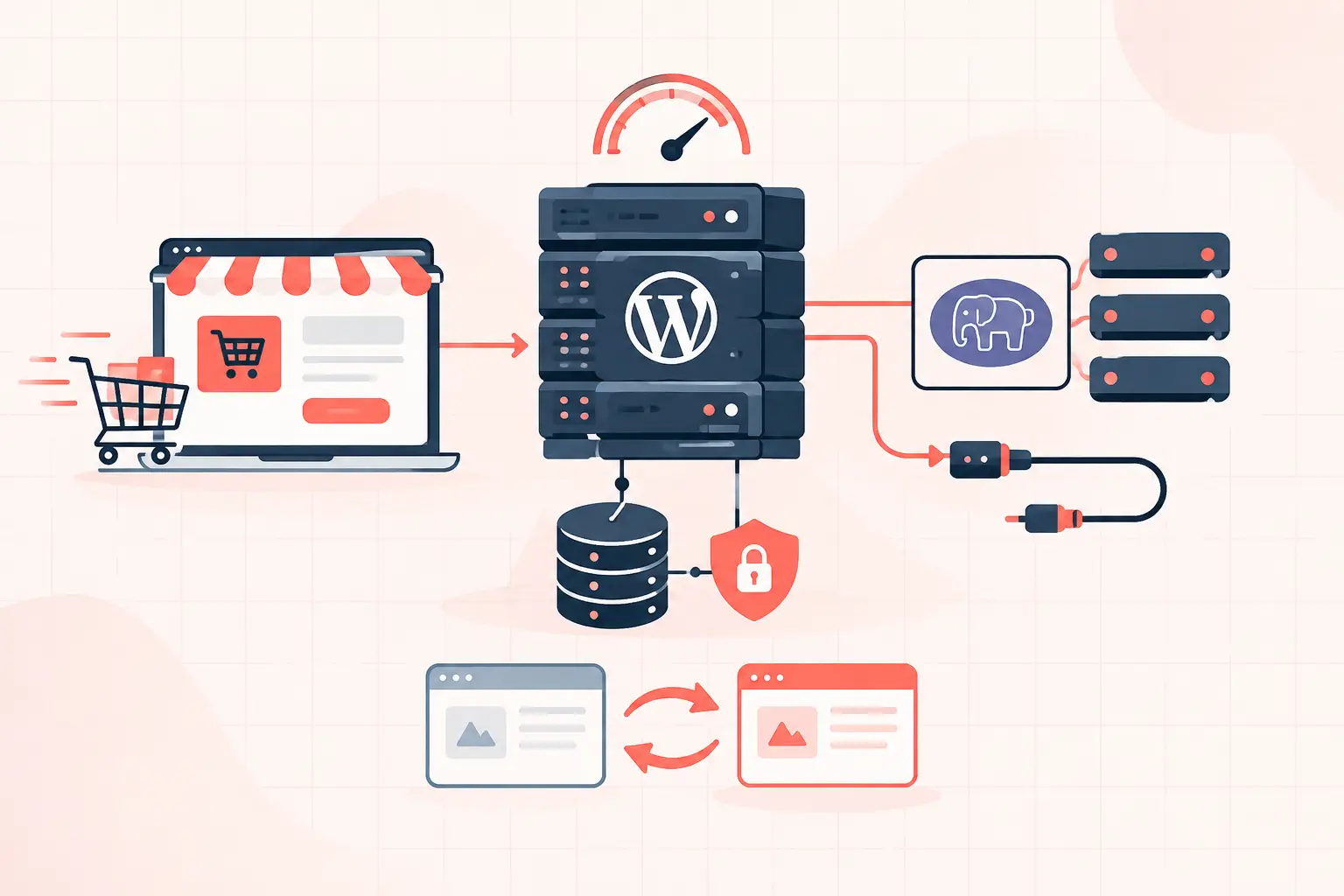


A WordPress site is usually slow for one of five reasons: high server response time, too much uncached dynamic work, expensive plugins or theme code, a bloated database, or insufficient hosting resources. If you are asking why WordPress slow, do not start by installing another optimization plugin. First identify whether the delay happens before the first byte, while PHP builds the page, or after the browser receives it. Each problem has a different fix.
The fastest way to narrow it down is to test a logged-out page and check Time to First Byte (TTFB). A consistently high TTFB points to the server, PHP, database, or cache path. A low TTFB with a slow visual load points to page weight, render-blocking assets, third-party scripts, or poor image handling.
Why Is WordPress Slow? Start With the Request Path
A page request moves through several layers: DNS, web server, PHP, WordPress, plugins, theme functions, database queries, object cache, and finally the browser. A slowdown at any layer can feel identical to a visitor, but the operational fix is not identical.
For a public blog post that can be page-cached, a good host should generally return HTML without booting WordPress for most anonymous visitors. For WooCommerce cart, checkout, account, and other personalized pages, full-page caching is limited by design. Those requests need efficient PHP execution, fast database access, enough PHP workers, and persistent object caching.
Before changing anything, record a baseline. Test the home page, a typical post or product page, and the cart or checkout if you sell online. Compare logged-out and logged-in results. If only logged-in requests are slow, page caching was never the answer.
| Symptom | Likely cause | First place to inspect |
|---|---|---|
| TTFB above 1 second on cached pages | Cache misses, overloaded server, slow origin | Page cache headers and server load |
| Product pages slow but posts are fast | WooCommerce queries or plugin hooks | Query Monitor, slow query logs |
| Site slows down during promotions | PHP worker contention or database saturation | Concurrent requests and PHP-FPM status |
| Good lab score, slow real visitors | Third-party scripts, geographic latency, uncached paths | Real-user monitoring and waterfall tests |
Check Caching Before Blaming WordPress
A cache plugin can help, but it cannot compensate for a server that is overloaded or a cache that never serves hits. Inspect response headers from a logged-out request. You are looking for evidence that a full-page cache is serving the HTML and whether the request was a HIT or MISS.
If every anonymous visit is a miss, check the usual causes: cookies that bypass cache, overly broad exclusion rules, a cache plugin conflicting with server-level caching, or a CDN configuration that forwards unnecessary cookies. Membership, multilingual, personalization, and ecommerce features may require some exclusions. The goal is not to cache everything blindly. The goal is to cache safe, repeatable requests while preserving correct behavior.
Object caching is different. Redis or Memcached stores reusable WordPress objects, such as options and query results, so PHP does not repeatedly ask MySQL for the same data. It is especially valuable for WooCommerce, admin-heavy sites, and sites with frequent uncached traffic. Do not confuse a persistent object cache with browser caching or full-page caching. They solve different portions of the request.
Find Slow Plugins, Theme Code, and External Calls
Plugin count is a poor performance metric. Ten well-built plugins can be lighter than one plugin that runs expensive queries on every request. What matters is what executes, how often it executes, and whether it calls external services.
Use Query Monitor on staging or during a controlled test to inspect page generation time, database queries, HTTP API calls, and hooked functions. Look for one plugin or theme component consuming a disproportionate share of the request. Common offenders include visual builders loading excessive assets, related-post modules running broad queries, security plugins scanning during live traffic, statistics plugins writing on every visit, and abandoned add-ons that query autoloaded settings repeatedly.
External calls are a separate trap. A chat widget, review feed, font provider, tag manager container, fraud service, or API integration may delay rendering or hold up PHP if the request is made server-side. Disable one suspect at a time on staging, retest, and keep a written record. Randomly deactivating half the site is how teams create new problems without finding the old one.
For developers, profile the slow template path rather than guessing. Check for repeated `WP_Query` loops, unbounded `get_posts()` calls, remote requests in template code, and filters that run expensive logic inside product loops. A query that takes 40 milliseconds is not alarming once. Run it 100 times on a category page and it becomes the page.
Fix Database Bloat and Autoloaded Options
WordPress databases often become slow through accumulation rather than one dramatic failure. Expired transients, abandoned plugin tables, oversized post meta, Action Scheduler records, and unbounded logs all increase work for MySQL and backup processes.
Start with the `wp_options` table. WordPress loads rows marked `autoload = yes` on most requests. A modest autoloaded options footprint is normal. Several megabytes of stale plugin settings, cached payloads, or giant serialized arrays is not. Identify large rows before deleting anything. Some options are essential, and deleting them because they look unfamiliar can break checkout, licensing, or scheduled tasks.
WooCommerce stores substantial order and action data, particularly on busy stores. Review failed and completed scheduled actions, retain only logs you genuinely need, and make sure background jobs are not forced through every visitor request. A real server cron is more predictable than relying solely on `wp-cron.php` traffic.
In `wp-config.php`, disabling the pseudo-cron prevents WordPress from attempting scheduled work during normal page loads:
define('DISABLE_WP_CRON', true);That change requires a server cron job to call WordPress scheduled tasks on an appropriate schedule. Do not add the constant and forget the replacement job, or backups, emails, subscriptions, and scheduled publishing can fail quietly.
PHP Workers and CPU Matter More Than Most Hosts Admit
When a request cannot be served from full-page cache, it needs a PHP worker. Each worker processes one PHP request at a time. If all workers are busy, new requests wait in a queue. During a WooCommerce sale, that can mean slow carts, delayed checkout AJAX calls, and customers abandoning sessions before the server reports an obvious outage.
More workers are not automatically better. Each PHP process consumes memory, and too many workers can push a constrained server into swapping or make MySQL compete for CPU. The correct number depends on memory, average request duration, traffic bursts, and how much work each uncached request performs.
Watch for rising PHP queue time, CPU saturation, memory pressure, and slow database queries during the actual busy period. A host that only shows generic CPU percentages is giving you an incomplete picture. You need to know whether requests are waiting, whether cache hit rates drop, and whether a noisy neighbor is consuming shared resources.
Modern high-frequency CPUs make a material difference because WordPress is often latency-sensitive. Many PHP requests are not massively parallel tasks; they benefit from strong per-core performance. WP Tango, for example, uses dedicated AMD Ryzen 9950X hardware alongside server-level caching and persistent object caching, which addresses the infrastructure side of uncached WordPress work. That still does not excuse inefficient plugins or runaway queries, but it gives a healthy site room to handle real traffic.
Reduce Front-End Weight After TTFB Is Under Control
If the HTML arrives quickly but the page still feels slow, inspect the browser waterfall. Large hero images, too many JavaScript bundles, render-blocking CSS, font files, and third-party tags are common causes of poor Largest Contentful Paint and Interaction to Next Paint.
Serve properly sized images, use modern formats where supported, and avoid loading a 2500-pixel image into a 600-pixel card. Delay nonessential scripts only after verifying critical functions still work. Consent tools, analytics, payment widgets, and accessibility overlays can all change page behavior when deferred.
Be cautious with blanket minification and script-combining settings. On HTTP/2 and HTTP/3, combining every file is not automatically faster. Aggressive optimization can also break dynamic checkout behavior, builder previews, and JavaScript-dependent menus. Test the pages that make money, not just a home-page score.
A Practical Order of Operations
Work from the largest measurable delay to the smallest. Confirm cache behavior and TTFB first. Then profile PHP, queries, and external calls on uncached pages. Clean database problems with backups and staging tests. Finally, tune front-end assets and third-party scripts.
Do not accept "WordPress is slow" as a diagnosis. It is a symptom. Once you can name the slow request type, the blocked resource, or the saturated server component, you can fix the cause without gambling with a stack of optimization plugins.